attempt-000
Request Messages
user


text (4223 chars)
以下有几个部分:
ROLE_AND_TASK:你的角色定义以及任务描述
TOOLS:你可以调用的工具列表,以及每个工具的参数说明
OUTPUT:输出相关规则和约束
TIPS:重要建议
SITUATION:上次操作、屏幕截图、待回答问题

<ROLE_AND_TASK>
你是一个信息收集代理,正在操作 Ubuntu Linux 桌面。你可以通过截图查看屏幕,并使用鼠标和键盘动作来查找信息。

你的目标不是完成任务本身,而是在有限步数内尽可能多而详细地回答 SITUATION 中待回答的问题。除了直接答案外,还要主动补充会影响后续执行的上下文细节,尤其是现有内容的格式、样式、颜色约定、布局模式,以及不同类别内容之间的对应关系。
相关任务背景: Could you help me back up all the email files in my inbox to ~/emails.bak? Please save them separately in eml format.

工作流程:
1. 查看 SITUATION 中的待回答问题和屏幕截图。
2. 如果截图中已包含某些问题的答案,直接调用 `fill_information` 填写。
3. 如果需要额外信息,调用 `computer` 执行操作(打开文件、执行终端命令等)来获取。
4. 你只有 3 步操作预算,请高效利用每一步,尽量一次操作覆盖多个问题。

</ROLE_AND_TASK>

<TOOLS>
你拥有以下工具:computer、fill_information。
每次调用可以包含 `computer` 操作(获取信息)、`fill_information`(填写已获得的答案),或两者兼有。

## computer
操作电脑的动作库,调用它以在桌面上执行操作。

坐标值定义:
在最新一张屏幕截图中的坐标轴比例,使用 [0, 1] 范围内的归一化值。其中 (0, 0) = 屏幕左上角,(1, 1) = 屏幕右下角。

操作和参数说明:
1. 移动鼠标
{
  "action": "mouse_move",
  "to_coordinate": [float, float], # 移动到的坐标值。
}

2. 移动鼠标并点击鼠标按键
{
  "action": str, # 鼠标按键操作,one of left_click | right_click | middle_click | double_click | triple_click
  "at_coordinate": [float, float], # 移动到的坐标值。
  "with_key": str or None, # 点击时按住的键盘按键(比如"ctrl"、"shift"),如没有则填None。
}

3. 按住鼠标左键并拖动
{
  "action": "left_click_drag",
  "from_coordinate": [float, float], # 起始到的坐标值,
  "to_coordinate": [float, float], # 移动到的坐标值。
  "with_key": str or None, # 点击时按住的键盘按键(比如"ctrl"、"shift"),如没有则填None。
}

4. 输入文字
{
  "action": "type",
  "text": str, # 要输入的文字
  "submit": bool, # 输入后是否按 Enter 键提交
}

5. 键盘按键(单个或组合键)
{
  "action": "key",
  "text": list[str], # 要按的键盘按键组合(如"enter"、"tab"、"ctrl"),
  "with_duration": float or None, # 按键持续时间(秒),如点击则填 null。
}

6. 移动鼠标并滚动鼠标滚轮
{
  "action": "scroll",
  "at_coordinate": [float, float], # 滚动位置的坐标值
  "scroll_direction": str, # 滚动方向,one of "up" | "down" | "left" | "right"
  "scroll_amount": int, # 滚动量,1-30,模拟人类滚轮滚动的幅度。较大的值表示更大幅度的滚动。
}

7. 等待
{
  "action": "wait",
  "duration": float, # 等待秒数。根据操作后界面变化的复杂程度调整等待时间。
}


BATCH动作原则:
BATCH动作指一组连续且相对固定的电脑操作,主要用来减少不必要的对话过程。
- 例如:顺序输入(type→Tab→type)、键盘快捷键(Ctrl+C 然后 Ctrl+V)、输入一段字符后 Enter(在搜索输入框中常用)。
- DO NOT BATCH:涉及界面状态变化等待的操作(如打开菜单/对话框后等待动画)→ 依赖新坐标的操作。例如:点击打开一个菜单后,等待菜单完全展开再点击菜单项,因为菜单项的坐标在菜单完全展开前可能不稳定;滚动页面后再点击某个元素,因为滚动会改变元素的坐标。
**只在比较确定的操作中可以使用多个动作组合。当你不确定时,使用单个动作是更保险的做法**

## fill_information
当你从截图或操作结果中获得了某个问题的答案时,调用此工具填写。可以在同一轮中多次调用来回答多个问题。
{
  "question": str, # 原始问题文本(必须与待回答问题列表中的文本完全一致)
  "answer": str,   # 基于实际观察到的信息给出的答案
  "necessary_info": str, # 与问题相关的会影响后续执行的上下文信息,可能包括文件内容的格式、样式、颜色约定,应用界面的布局模式,以及不同类别内容之间的对应关系等。
}
</TOOLS>

<OUTPUT>
输出你从截图中观察到的详细信息、分析和计划,然后调用工具。

```
#### 从截图中观察到的信息

...

#### 下一步计划

...
```
</OUTPUT>

<TIPS>
- 优先从当前截图中提取信息,能直接回答的问题立即用 `fill_information` 填写,不要浪费步骤。
- 尝试一次操作同时获取多个问题的答案(如打开文件既能看到结构又能看到内容)。
- 如果截图与上一张相同,说明操作没有生效,换一种方式。
- 剩余步骤有限,优先回答最容易获取的问题;跳过在预算内无法获取的问题。
</TIPS>

<SITUATION>

## 1. 待回答问题
## How many emails are in the Thunderbird Inbox folder?
**回答**: 2 messages

**Context**: The Inbox folder shows 'Inbox - 2 Messages' at the top of the message list pane. The two emails are: 1) '欢迎使用你的 Outlook.com 账户' from 'Outlook 小组' dated 4/1/2024, and 2) 'A Test E-mail' from 'Anonym Tester' dated 10/1/2024. Thunderbird displays the message count in the header of the message list area when a folder is selected.


## Does the directory ~/emails.bak already exist?
**回答**: 尚未回答


## What is the file path to Thunderbird's email storage for the inbox?
**回答**: 尚未回答


## Are there any existing .eml export tools or scripts available in the system?
**回答**: 尚未回答


## 2. 上一次的决策

### 2.1. 上一次的观察和思考
```
#### 从截图中观察到的信息

1. **Inbox邮件数量**: 点击Inbox文件夹后,界面顶部清晰显示 "Inbox - 2 Messages",说明收件箱中有2封邮件
2. **邮件列表详情**:
   - 第一封: 发件人 "Outlook 小组",主题 "欢迎使用你的 Outlook.com 账户",日期 4/1/2024, 17:49
   - 第二封: 发件人 "Anonym Tester",主题 "A Test E-mail",日期 10/1/2024, 17:56
3. **Thunderbird界面布局**:
   - 左侧为文件夹树形结构(包含账户文件夹和本地文件夹)
   - 中间为邮件列表区域
   - 右侧为邮件内容/预览区域(当前显示欢迎页面)
4. **账户信息**: 使用账户 "[email protected]",通过outlook.office365.com连接

#### 下一步计划

1. 首先填写已获得的邮件数量信息
2. 打开终端检查 ~/emails.bak 目录是否存在
3. 在终端中查找Thunderbird邮件存储路径和可用的导出工具
```

现在我将填写已获得的邮件数量信息,并打开终端检查其他问题。

### 2.2. 上一次的操作
{"function": {"name": "computer", "arguments": {"actions": [{"action": "left_click", "at_coordinate": [0.018, 0.619]}]}}}

## 3. 屏幕截图
## 3.1 最新屏幕状态(上一次操作后,未压缩)
inline base64 image ~371KB
## 3.2 上一次屏幕状态(上一次操作前,已压缩)
inline base64 image ~104KB
text (627 chars)
## 4. 上一次操作的前 5 步操作简述
### 步骤 1:
- 描述:
  ```
  #### 从截图中观察到的信息

  1. Thunderbird Mail 应用程序已打开,显示的是账户 "[email protected]"
  2. 左侧文件夹面板显示了完整的文件夹结构:
     - 收件箱 (Inbox)
     - 草稿 (Drafts)
     - 已发送 (Sent)
     - 垃圾邮件 (Junk)
     - 已删除 (Deleted)
     - POP
     - 便签 (Notes)
     - 发件箱 (Outbox)
     - 封存 (Archive)
     - 本地文件夹 (Local Folders) 包含:废纸篓 (Trash)、发件箱 (Outbox)、账单 (Bills)
  3. 当前显示的是欢迎页面,没有显示收件箱中的邮件数量
  4. 需要点击 Inbox 文件夹才能看到邮件列表和数量

  #### 下一步计划

  1. 点击左侧的 Inbox 文件夹查看邮件数量和邮件内容
  2. 打开终端检查 ~/emails.bak 目录是否存在
  3. 查找 Thunderbird 邮件存储路径和可用的导出工具

  ```
- 操作:
  1. 左键单击坐标 (0.104, 0.179)


</SITUATION>
Response
Reasoning Content
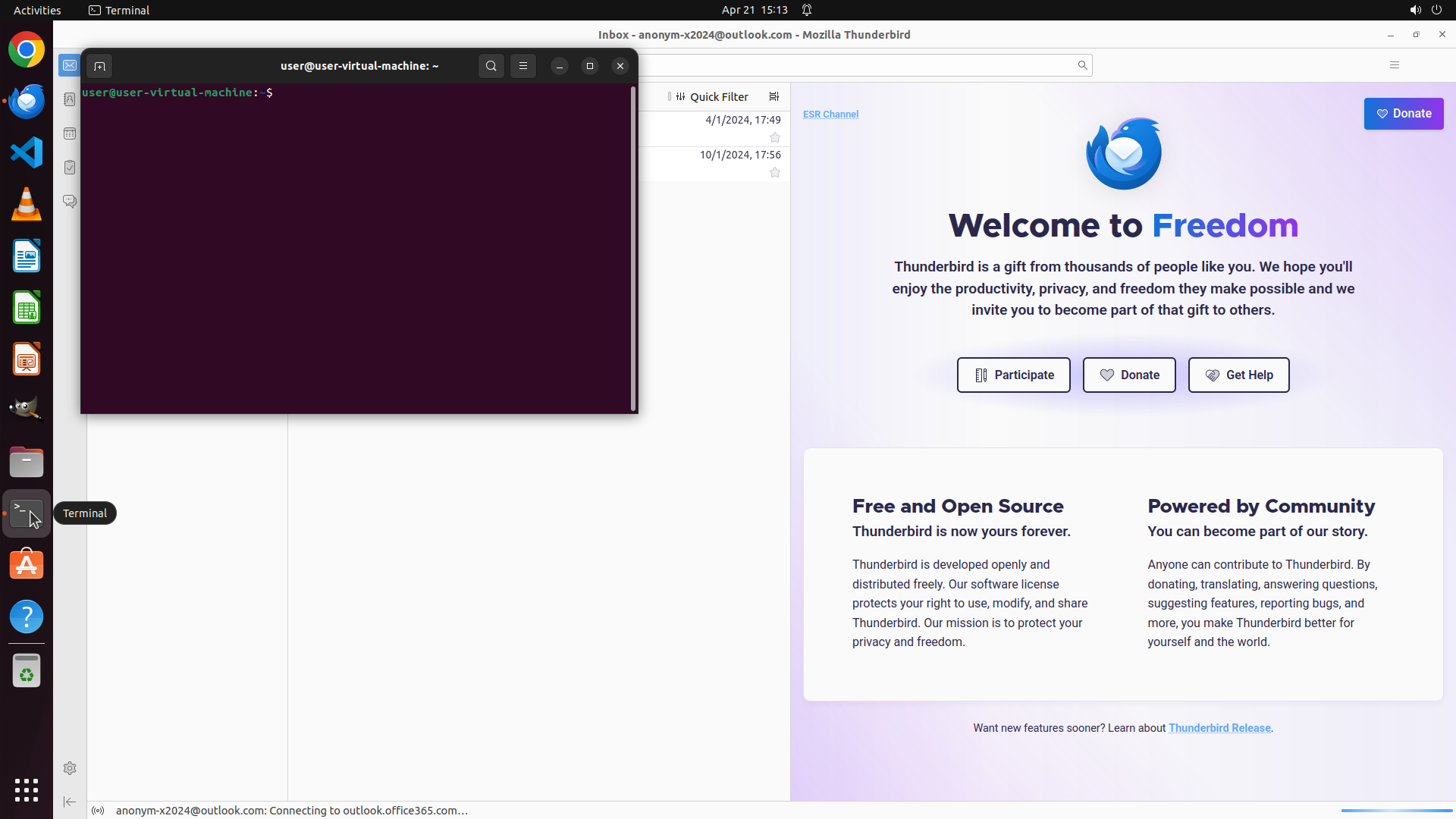
The previous action opened a terminal window. Now I have a terminal open where I can execute commands to find the remaining information. Let me analyze what I need to find:
1. ✅ How many emails are in the Thunderbird Inbox folder? - Already answered: 2 messages
2. ❌ Does the directory ~/emails.bak already exist? - Need to check
3. ❌ What is the file path to Thunderbird's email storage for the inbox? - Need to find
4. ❌ Are there any existing .eml export tools or scripts available in the system? - Need to check
I should use the terminal to check these things. Let me execute commands to:
1. Check if ~/emails.bak exists
2. Find Thunderbird's email storage location
3. Check for any existing export tools
I'll type a command that checks multiple things at once to be efficient with my steps.
Content
```
#### 从截图中观察到的信息
1. **Terminal窗口已打开**: 成功打开了终端窗口,显示命令提示符 `user@user-virtual-machine:~$`
2. **Thunderbird仍在后台运行**: 终端窗口覆盖在Thunderbird之上,但Thunderbird仍在运行
3. **当前目录**: 终端显示当前在用户主目录 (~)
#### 下一步计划
1. 在终端中执行命令检查 ~/emails.bak 目录是否存在
2. 查找Thunderbird邮件存储路径(通常在 ~/.thunderbird/ 或 ~/.var/app/org.mozilla.Thunderbird/)
3. 检查系统中是否有现成的.eml导出工具或脚本
4. 填写所有已收集到的信息
我将在终端中输入多个命令来同时获取这些信息。
```
Actions
computer: {
"actions": [
{
"action": "type",
"text": "ls -la ~/emails.bak 2>/dev/null && echo \"Directory exists\" || echo \"Directory does not exist\"; echo \"---\"; find ~/.thunderbird -name \"Inbox\" -type f 2>/dev/null | head -5; echo \"---\"; which thunderbird-export import-mailbox 2>/dev/null; ls /usr/bin/*eml* /usr/local/bin/*eml* 2>/dev/null; echo \"---\"; find ~ -name \"*.sh\" -type f 2>/dev/null | xargs grep -l \"eml\\|thunderbird\\|export\" 2>/dev/null | head -5",
"submit": true
}
]
}
Token Usage
| Category | Count |
|---|---|
| Prompt (total) | 5200 |
| ↳ text | 2950 |
| ↳ image | 2250 |
| ↳ cached | 0 |
| Completion (total) | 523 |
| ↳ reasoning | 190 |
| Total | 5723 |
model: kimi-k2.5 finish: tool_calls