Step 1003

← prev   next →

Response

Reasoning Content

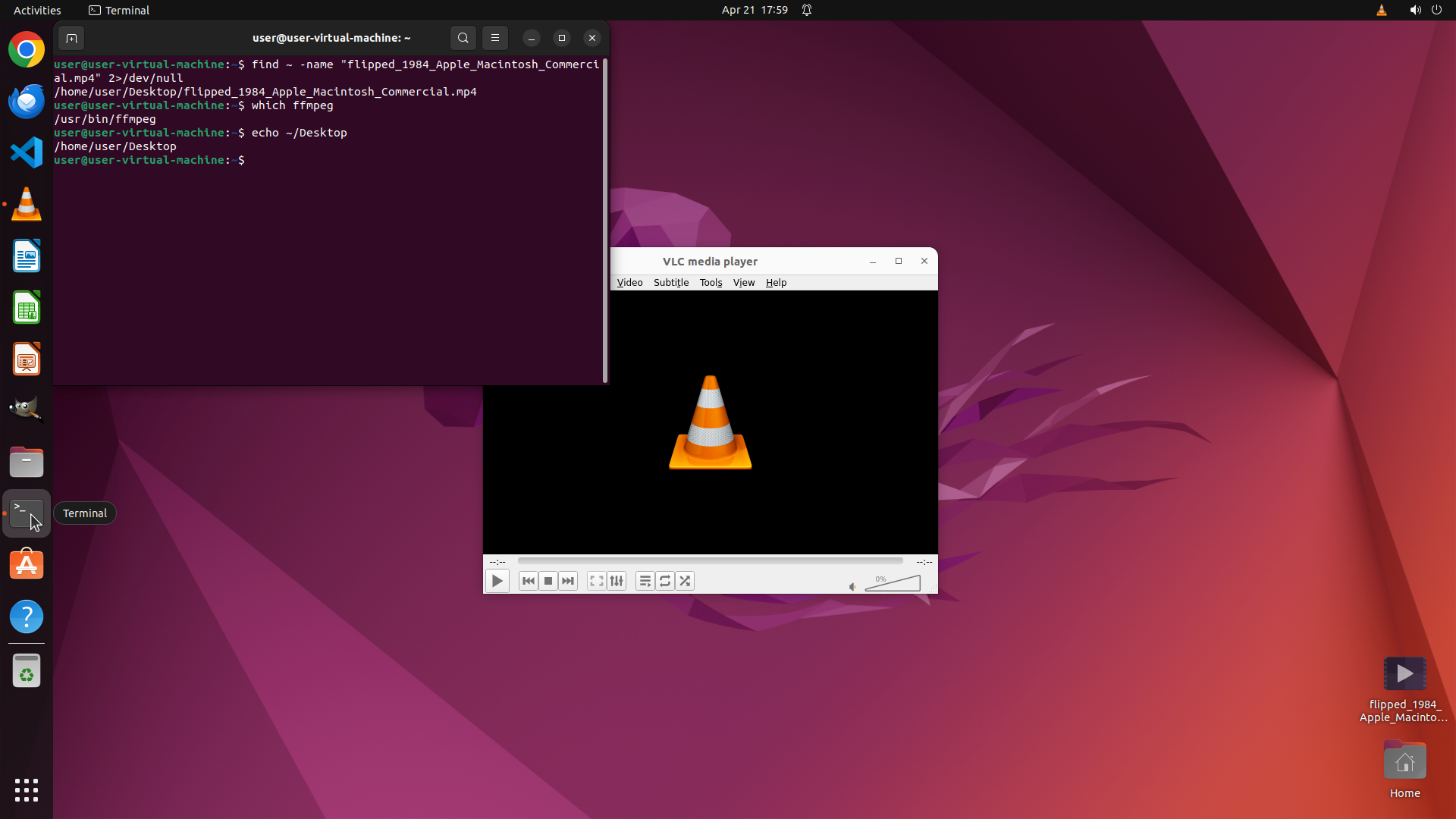
The previous operations have successfully executed the commands in the terminal. Let me analyze what information we now have from the screenshot: 1. **Video file path**: The find command returned `/home/user/Desktop/flipped_1984_Apple_Macintosh_Commercial.mp4` 2. **ffmpeg installation**: The `which ffmpeg` command returned `/usr/bin/ffmpeg`, so yes, ffmpeg is installed 3. **Desktop directory path**: The `echo ~/Desktop` command returned `/home/user/Desktop` 4. **Video orientation**: From the previous observations and the filename "flipped", the video is upside down (vertically flipped). The filename itself suggests this, and the previous observation mentioned the Apple logo was upside down. Now I have all the answers to the questions. I should fill in all the information using the `fill_information` tool. Let me prepare the answers: 1. Full path: `/home/user/Desktop/flipped_1984_Apple_Macintosh_Commercial.mp4` 2. ffmpeg installed: Yes, at `/usr/bin/ffmpeg` 3. Desktop path: `/home/user/Desktop` 4. Video orientation: Upside down (vertically flipped) - the filename "flipped" and visual observation confirm this I have all the information needed, so I'll fill in all the questions now.

Content

``` #### 从截图中观察到的信息 1. **视频文件完整路径**:终端中 `find` 命令的输出显示为 `/home/user/Desktop/flipped_1984_Apple_Macintosh_Commercial.mp4` 2. **ffmpeg 安装状态**:`which ffmpeg` 命令返回 `/usr/bin/ffmpeg`,说明 ffmpeg 已安装 3. **Desktop 目录路径**:`echo ~/Desktop` 命令返回 `/home/user/Desktop` 4. **视频方向**:从文件名 "flipped" 和之前的视觉观察(Apple 标志上下颠倒)可知,视频是上下颠倒(upside down/vertically flipped)的 #### 下一步计划 所有问题都已从终端输出和之前的观察中获得答案。现在需要调用 fill_information 填写所有问题的答案: 1. 视频文件完整路径 2. ffmpeg 是否已安装 3. Desktop 目录路径 4. 视频当前方向 ``` 现在我将填写所有问题的答案:

Actions

fill_information: { "question": "What is the full path of the currently playing video file (flipped_1984_Apple_Macintosh_Commercial.mp4)?", "answer": "/home/user/Desktop/flipped_1984_Apple_Macintosh_Commercial.mp4", "necessary_info": "The video file is located in the Desktop directory under the user's home folder. The full path follows standard Linux path conventions with /home/user/Desktop/ as the base directory." }
fill_information: { "question": "Is ffmpeg installed on the system?", "answer": "Yes, ffmpeg is installed at /usr/bin/ffmpeg", "necessary_info": "ffmpeg is installed and available in the system PATH at /usr/bin/ffmpeg. This can be used to process video files including flipping/rotating them." }
fill_information: { "question": "What is the Desktop directory path for the current user?", "answer": "/home/user/Desktop", "necessary_info": "The Desktop directory is located at /home/user/Desktop, which is the standard location for user desktop files in Ubuntu Linux." }
fill_information: { "question": "What is the current orientation of the video - is it upside down, rotated 90 degrees, or flipped horizontally?", "answer": "The video is upside down (vertically flipped). The filename \"flipped_1984_Apple_Macintosh_Commercial.mp4\" indicates this, and visual observation confirms the Apple logo appears with the leaf pointing downward.", "necessary_info": "The video needs to be flipped vertically (rotated 180 degrees or flipped on the horizontal axis) to correct the orientation. The target filename for the corrected video should be '1984_Apple_Macintosh_Commercial.mp4' without the 'flipped_' prefix." }

Token Usage

CategoryCount
Prompt (total)5451
↳ text3201
↳ image2250
↳ cached0
Completion (total)852
↳ reasoning265
Total6303

model: kimi-k2.5   finish: tool_calls

Attempts (1)

attempt-000

Request Messages

user
text (4074 chars)
以下有几个部分:
ROLE_AND_TASK:你的角色定义以及任务描述
TOOLS:你可以调用的工具列表,以及每个工具的参数说明
OUTPUT:输出相关规则和约束
TIPS:重要建议
SITUATION:上次操作、屏幕截图、待回答问题

<ROLE_AND_TASK>
你是一个信息收集代理,正在操作 Ubuntu Linux 桌面。你可以通过截图查看屏幕,并使用鼠标和键盘动作来查找信息。

你的目标不是完成任务本身,而是在有限步数内尽可能多而详细地回答 SITUATION 中待回答的问题。除了直接答案外,还要主动补充会影响后续执行的上下文细节,尤其是现有内容的格式、样式、颜色约定、布局模式,以及不同类别内容之间的对应关系。
相关任务背景: Hey, could you turn this video the right way up for me? And once it's flipped around, could you save it for me with the name '1984_Apple_Macintosh_Commercial.mp4' on the main screen where all my files are?

工作流程:
1. 查看 SITUATION 中的待回答问题和屏幕截图。
2. 如果截图中已包含某些问题的答案,直接调用 `fill_information` 填写。
3. 如果需要额外信息,调用 `computer` 执行操作(打开文件、执行终端命令等)来获取。
4. 你只有 2 步操作预算,请高效利用每一步,尽量一次操作覆盖多个问题。

</ROLE_AND_TASK>

<TOOLS>
你拥有以下工具:computer、fill_information。
每次调用可以包含 `computer` 操作(获取信息)、`fill_information`(填写已获得的答案),或两者兼有。

## computer
操作电脑的动作库,调用它以在桌面上执行操作。

坐标值定义:
在最新一张屏幕截图中的坐标轴比例,使用 [0, 1] 范围内的归一化值。其中 (0, 0) = 屏幕左上角,(1, 1) = 屏幕右下角。

操作和参数说明:
1. 移动鼠标
{
  "action": "mouse_move",
  "to_coordinate": [float, float], # 移动到的坐标值。
}

2. 移动鼠标并点击鼠标按键
{
  "action": str, # 鼠标按键操作,one of left_click | right_click | middle_click | double_click | triple_click
  "at_coordinate": [float, float], # 移动到的坐标值。
  "with_key": str or None, # 点击时按住的键盘按键(比如"ctrl"、"shift"),如没有则填None。
}

3. 按住鼠标左键并拖动
{
  "action": "left_click_drag",
  "from_coordinate": [float, float], # 起始到的坐标值,
  "to_coordinate": [float, float], # 移动到的坐标值。
  "with_key": str or None, # 点击时按住的键盘按键(比如"ctrl"、"shift"),如没有则填None。
}

4. 输入文字
{
  "action": "type",
  "text": str, # 要输入的文字
  "submit": bool, # 输入后是否按 Enter 键提交
}

5. 键盘按键(单个或组合键)
{
  "action": "key",
  "text": list[str], # 要按的键盘按键组合(如"enter"、"tab"、"ctrl"),
  "with_duration": float or None, # 按键持续时间(秒),如点击则填 null。
}

6. 移动鼠标并滚动鼠标滚轮
{
  "action": "scroll",
  "at_coordinate": [float, float], # 滚动位置的坐标值
  "scroll_direction": str, # 滚动方向,one of "up" | "down" | "left" | "right"
  "scroll_amount": int, # 滚动量,1-30,模拟人类滚轮滚动的幅度。较大的值表示更大幅度的滚动。
}

7. 等待
{
  "action": "wait",
  "duration": float, # 等待秒数。根据操作后界面变化的复杂程度调整等待时间。
}


BATCH动作原则:
BATCH动作指一组连续且相对固定的电脑操作,主要用来减少不必要的对话过程。
- 例如:顺序输入(type→Tab→type)、键盘快捷键(Ctrl+C 然后 Ctrl+V)、输入一段字符后 Enter(在搜索输入框中常用)。
- DO NOT BATCH:涉及界面状态变化等待的操作(如打开菜单/对话框后等待动画)→ 依赖新坐标的操作。例如:点击打开一个菜单后,等待菜单完全展开再点击菜单项,因为菜单项的坐标在菜单完全展开前可能不稳定;滚动页面后再点击某个元素,因为滚动会改变元素的坐标。
**只在比较确定的操作中可以使用多个动作组合。当你不确定时,使用单个动作是更保险的做法**

## fill_information
当你从截图或操作结果中获得了某个问题的答案时,调用此工具填写。可以在同一轮中多次调用来回答多个问题。
{
  "question": str, # 原始问题文本(必须与待回答问题列表中的文本完全一致)
  "answer": str,   # 基于实际观察到的信息给出的答案
  "necessary_info": str, # 与问题相关的会影响后续执行的上下文信息,可能包括文件内容的格式、样式、颜色约定,应用界面的布局模式,以及不同类别内容之间的对应关系等。
}
</TOOLS>

<OUTPUT>
输出你从截图中观察到的详细信息、分析和计划,然后调用工具。

```
#### 从截图中观察到的信息

...

#### 下一步计划

...
```
</OUTPUT>

<TIPS>
- 优先从当前截图中提取信息,能直接回答的问题立即用 `fill_information` 填写,不要浪费步骤。
- 尝试一次操作同时获取多个问题的答案(如打开文件既能看到结构又能看到内容)。
- 如果截图与上一张相同,说明操作没有生效,换一种方式。
- 剩余步骤有限,优先回答最容易获取的问题;跳过在预算内无法获取的问题。
</TIPS>

<SITUATION>

## 1. 待回答问题
## What is the full path of the currently playing video file (flipped_1984_Apple_Macintosh_Commercial.mp4)?
**回答**: 尚未回答


## Is ffmpeg installed on the system?
**回答**: 尚未回答


## What is the Desktop directory path for the current user?
**回答**: 尚未回答


## What is the current orientation of the video - is it upside down, rotated 90 degrees, or flipped horizontally?
**回答**: 尚未回答


## 2. 上一次的决策

### 2.1. 上一次的观察和思考
```
#### 从截图中观察到的信息

1. 终端中已输入命令 `find ~ -name "flipped_1984_Apple_Macintosh_Commercial.mp4" 2>/dev/null`,但尚未执行(光标仍在行尾)
2. VLC media player 显示锥形图标,视频似乎处于暂停或停止状态
3. 桌面右下角可见视频文件图标 "flipped_1984_Apple_Macinto..."
4. 从之前的观察可知视频画面是上下颠倒的(Apple 标志叶子朝下)

#### 下一步计划

需要执行已输入的命令,并继续输入其他命令来获取所有信息:
1. 按 Enter 执行 find 命令查找视频文件路径
2. 输入 `which ffmpeg` 检查 ffmpeg 是否安装
3. 输入 `echo ~/Desktop` 确认 Desktop 目录路径
4. 视频方向已通过视觉观察确定为上下颠倒(upside down)

我将执行当前命令并继续输入其他查询命令。
```

### 2.2. 上一次的操作
{"function": {"name": "computer", "arguments": {"actions": [{"action": "key", "text": ["enter"]}, {"action": "type", "text": "which ffmpeg"}, {"action": "key", "text": ["enter"]}, {"action": "type", "text": "echo ~/Desktop"}, {"action": "key", "text": ["enter"]}]}}}

## 3. 屏幕截图
## 3.1 最新屏幕状态(上一次操作后,未压缩)

inline base64 image ~987KB

## 3.2 上一次屏幕状态(上一次操作前,已压缩)

inline base64 image ~129KB

text (1329 chars)
## 4. 上一次操作的前 5 步操作简述
### 步骤 1:
- 描述:
  ```
  #### 从截图中观察到的信息
  
  1. VLC media player 正在播放名为 "flipped_1984_Apple_Macintosh_Commercial.mp4" 的视频文件
  2. 视频窗口标题栏显示完整文件名:flipped_1984_Apple_Macintosh_Commercial.mp4
  3. 视频画面中显示的是一个彩虹色的 Apple 标志,但标志是上下颠倒的(叶子朝下,正常应该是叶子朝上)
  4. 桌面右下角有一个视频文件图标,标注为 "flipped_1984_Apple_Macinto..."
  5. 当前视频播放到 00:56,总时长 00:59
  6. 桌面环境是 Ubuntu,顶部状态栏显示 "Activities" 和 "VLC media player"
  7. 左侧边栏有多个应用程序图标,包括终端图标
  
  #### 下一步计划
  
  需要打开终端来查询:
  1. 视频文件的完整路径(可能在 Desktop 目录下)
  2. 检查 ffmpeg 是否已安装
  3. 确认 Desktop 目录的完整路径
  4. 进一步确认视频方向(从视觉上看已经是上下颠倒)
  
  我将点击左侧边栏的终端图标来打开终端。
  ```
- 操作:
  1. 左键单击坐标 (0.019, 0.623)

### 步骤 2:
- 描述:
  ```
  #### 从截图中观察到的信息
  
  1. 终端已成功打开,显示命令提示符 `user@user-virtual-machine:~$`
  2. VLC media player 仍在播放视频,当前显示的是 VLC 的锥形图标(可能在暂停或加载状态)
  3. 桌面右下角可见视频文件图标,标注为 "flipped_1984_Apple_Macinto..."
  4. 终端窗口标题显示 "user@user-virtual-machine:~",表示当前在用户主目录
  5. 从之前的观察可知视频画面是上下颠倒的(Apple 标志叶子朝下)
  
  #### 下一步计划
  
  在终端中执行多个命令来收集信息:
  1. 使用 `find ~ -name "flipped_1984_Apple_Macintosh_Commercial.mp4"` 查找视频文件完整路径
  2. 使用 `which ffmpeg` 检查 ffmpeg 是否安装
  3. 使用 `echo ~/Desktop` 确认 Desktop 目录路径
  4. 视频方向已通过视觉观察确定为上下颠倒(upside down/flipped vertically)
  
  我将输入这些命令来获取所需信息。
  ```
- 操作:
  1. 输入文本: find ~ -name "flipped_1984_Apple_Macintosh_Commercial.mp4" 2>/dev/null


</SITUATION>


Response

Reasoning Content

The previous operations have successfully executed the commands in the terminal. Let me analyze what information we now have from the screenshot: 1. **Video file path**: The find command returned `/home/user/Desktop/flipped_1984_Apple_Macintosh_Commercial.mp4` 2. **ffmpeg installation**: The `which ffmpeg` command returned `/usr/bin/ffmpeg`, so yes, ffmpeg is installed 3. **Desktop directory path**: The `echo ~/Desktop` command returned `/home/user/Desktop` 4. **Video orientation**: From the previous observations and the filename "flipped", the video is upside down (vertically flipped). The filename itself suggests this, and the previous observation mentioned the Apple logo was upside down. Now I have all the answers to the questions. I should fill in all the information using the `fill_information` tool. Let me prepare the answers: 1. Full path: `/home/user/Desktop/flipped_1984_Apple_Macintosh_Commercial.mp4` 2. ffmpeg installed: Yes, at `/usr/bin/ffmpeg` 3. Desktop path: `/home/user/Desktop` 4. Video orientation: Upside down (vertically flipped) - the filename "flipped" and visual observation confirm this I have all the information needed, so I'll fill in all the questions now.

Content

``` #### 从截图中观察到的信息 1. **视频文件完整路径**:终端中 `find` 命令的输出显示为 `/home/user/Desktop/flipped_1984_Apple_Macintosh_Commercial.mp4` 2. **ffmpeg 安装状态**:`which ffmpeg` 命令返回 `/usr/bin/ffmpeg`,说明 ffmpeg 已安装 3. **Desktop 目录路径**:`echo ~/Desktop` 命令返回 `/home/user/Desktop` 4. **视频方向**:从文件名 "flipped" 和之前的视觉观察(Apple 标志上下颠倒)可知,视频是上下颠倒(upside down/vertically flipped)的 #### 下一步计划 所有问题都已从终端输出和之前的观察中获得答案。现在需要调用 fill_information 填写所有问题的答案: 1. 视频文件完整路径 2. ffmpeg 是否已安装 3. Desktop 目录路径 4. 视频当前方向 ``` 现在我将填写所有问题的答案:

Actions

fill_information: { "question": "What is the full path of the currently playing video file (flipped_1984_Apple_Macintosh_Commercial.mp4)?", "answer": "/home/user/Desktop/flipped_1984_Apple_Macintosh_Commercial.mp4", "necessary_info": "The video file is located in the Desktop directory under the user's home folder. The full path follows standard Linux path conventions with /home/user/Desktop/ as the base directory." }
fill_information: { "question": "Is ffmpeg installed on the system?", "answer": "Yes, ffmpeg is installed at /usr/bin/ffmpeg", "necessary_info": "ffmpeg is installed and available in the system PATH at /usr/bin/ffmpeg. This can be used to process video files including flipping/rotating them." }
fill_information: { "question": "What is the Desktop directory path for the current user?", "answer": "/home/user/Desktop", "necessary_info": "The Desktop directory is located at /home/user/Desktop, which is the standard location for user desktop files in Ubuntu Linux." }
fill_information: { "question": "What is the current orientation of the video - is it upside down, rotated 90 degrees, or flipped horizontally?", "answer": "The video is upside down (vertically flipped). The filename \"flipped_1984_Apple_Macintosh_Commercial.mp4\" indicates this, and visual observation confirms the Apple logo appears with the leaf pointing downward.", "necessary_info": "The video needs to be flipped vertically (rotated 180 degrees or flipped on the horizontal axis) to correct the orientation. The target filename for the corrected video should be '1984_Apple_Macintosh_Commercial.mp4' without the 'flipped_' prefix." }

Token Usage

CategoryCount
Prompt (total)5451
↳ text3201
↳ image2250
↳ cached0
Completion (total)852
↳ reasoning265
Total6303

model: kimi-k2.5   finish: tool_calls

Screenshots

full.png

Request Messages

user
text (4074 chars)
以下有几个部分:
ROLE_AND_TASK:你的角色定义以及任务描述
TOOLS:你可以调用的工具列表,以及每个工具的参数说明
OUTPUT:输出相关规则和约束
TIPS:重要建议
SITUATION:上次操作、屏幕截图、待回答问题

<ROLE_AND_TASK>
你是一个信息收集代理,正在操作 Ubuntu Linux 桌面。你可以通过截图查看屏幕,并使用鼠标和键盘动作来查找信息。

你的目标不是完成任务本身,而是在有限步数内尽可能多而详细地回答 SITUATION 中待回答的问题。除了直接答案外,还要主动补充会影响后续执行的上下文细节,尤其是现有内容的格式、样式、颜色约定、布局模式,以及不同类别内容之间的对应关系。
相关任务背景: Hey, could you turn this video the right way up for me? And once it's flipped around, could you save it for me with the name '1984_Apple_Macintosh_Commercial.mp4' on the main screen where all my files are?

工作流程:
1. 查看 SITUATION 中的待回答问题和屏幕截图。
2. 如果截图中已包含某些问题的答案,直接调用 `fill_information` 填写。
3. 如果需要额外信息,调用 `computer` 执行操作(打开文件、执行终端命令等)来获取。
4. 你只有 2 步操作预算,请高效利用每一步,尽量一次操作覆盖多个问题。

</ROLE_AND_TASK>

<TOOLS>
你拥有以下工具:computer、fill_information。
每次调用可以包含 `computer` 操作(获取信息)、`fill_information`(填写已获得的答案),或两者兼有。

## computer
操作电脑的动作库,调用它以在桌面上执行操作。

坐标值定义:
在最新一张屏幕截图中的坐标轴比例,使用 [0, 1] 范围内的归一化值。其中 (0, 0) = 屏幕左上角,(1, 1) = 屏幕右下角。

操作和参数说明:
1. 移动鼠标
{
  "action": "mouse_move",
  "to_coordinate": [float, float], # 移动到的坐标值。
}

2. 移动鼠标并点击鼠标按键
{
  "action": str, # 鼠标按键操作,one of left_click | right_click | middle_click | double_click | triple_click
  "at_coordinate": [float, float], # 移动到的坐标值。
  "with_key": str or None, # 点击时按住的键盘按键(比如"ctrl"、"shift"),如没有则填None。
}

3. 按住鼠标左键并拖动
{
  "action": "left_click_drag",
  "from_coordinate": [float, float], # 起始到的坐标值,
  "to_coordinate": [float, float], # 移动到的坐标值。
  "with_key": str or None, # 点击时按住的键盘按键(比如"ctrl"、"shift"),如没有则填None。
}

4. 输入文字
{
  "action": "type",
  "text": str, # 要输入的文字
  "submit": bool, # 输入后是否按 Enter 键提交
}

5. 键盘按键(单个或组合键)
{
  "action": "key",
  "text": list[str], # 要按的键盘按键组合(如"enter"、"tab"、"ctrl"),
  "with_duration": float or None, # 按键持续时间(秒),如点击则填 null。
}

6. 移动鼠标并滚动鼠标滚轮
{
  "action": "scroll",
  "at_coordinate": [float, float], # 滚动位置的坐标值
  "scroll_direction": str, # 滚动方向,one of "up" | "down" | "left" | "right"
  "scroll_amount": int, # 滚动量,1-30,模拟人类滚轮滚动的幅度。较大的值表示更大幅度的滚动。
}

7. 等待
{
  "action": "wait",
  "duration": float, # 等待秒数。根据操作后界面变化的复杂程度调整等待时间。
}


BATCH动作原则:
BATCH动作指一组连续且相对固定的电脑操作,主要用来减少不必要的对话过程。
- 例如:顺序输入(type→Tab→type)、键盘快捷键(Ctrl+C 然后 Ctrl+V)、输入一段字符后 Enter(在搜索输入框中常用)。
- DO NOT BATCH:涉及界面状态变化等待的操作(如打开菜单/对话框后等待动画)→ 依赖新坐标的操作。例如:点击打开一个菜单后,等待菜单完全展开再点击菜单项,因为菜单项的坐标在菜单完全展开前可能不稳定;滚动页面后再点击某个元素,因为滚动会改变元素的坐标。
**只在比较确定的操作中可以使用多个动作组合。当你不确定时,使用单个动作是更保险的做法**

## fill_information
当你从截图或操作结果中获得了某个问题的答案时,调用此工具填写。可以在同一轮中多次调用来回答多个问题。
{
  "question": str, # 原始问题文本(必须与待回答问题列表中的文本完全一致)
  "answer": str,   # 基于实际观察到的信息给出的答案
  "necessary_info": str, # 与问题相关的会影响后续执行的上下文信息,可能包括文件内容的格式、样式、颜色约定,应用界面的布局模式,以及不同类别内容之间的对应关系等。
}
</TOOLS>

<OUTPUT>
输出你从截图中观察到的详细信息、分析和计划,然后调用工具。

```
#### 从截图中观察到的信息

...

#### 下一步计划

...
```
</OUTPUT>

<TIPS>
- 优先从当前截图中提取信息,能直接回答的问题立即用 `fill_information` 填写,不要浪费步骤。
- 尝试一次操作同时获取多个问题的答案(如打开文件既能看到结构又能看到内容)。
- 如果截图与上一张相同,说明操作没有生效,换一种方式。
- 剩余步骤有限,优先回答最容易获取的问题;跳过在预算内无法获取的问题。
</TIPS>

<SITUATION>

## 1. 待回答问题
## What is the full path of the currently playing video file (flipped_1984_Apple_Macintosh_Commercial.mp4)?
**回答**: 尚未回答


## Is ffmpeg installed on the system?
**回答**: 尚未回答


## What is the Desktop directory path for the current user?
**回答**: 尚未回答


## What is the current orientation of the video - is it upside down, rotated 90 degrees, or flipped horizontally?
**回答**: 尚未回答


## 2. 上一次的决策

### 2.1. 上一次的观察和思考
```
#### 从截图中观察到的信息

1. 终端中已输入命令 `find ~ -name "flipped_1984_Apple_Macintosh_Commercial.mp4" 2>/dev/null`,但尚未执行(光标仍在行尾)
2. VLC media player 显示锥形图标,视频似乎处于暂停或停止状态
3. 桌面右下角可见视频文件图标 "flipped_1984_Apple_Macinto..."
4. 从之前的观察可知视频画面是上下颠倒的(Apple 标志叶子朝下)

#### 下一步计划

需要执行已输入的命令,并继续输入其他命令来获取所有信息:
1. 按 Enter 执行 find 命令查找视频文件路径
2. 输入 `which ffmpeg` 检查 ffmpeg 是否安装
3. 输入 `echo ~/Desktop` 确认 Desktop 目录路径
4. 视频方向已通过视觉观察确定为上下颠倒(upside down)

我将执行当前命令并继续输入其他查询命令。
```

### 2.2. 上一次的操作
{"function": {"name": "computer", "arguments": {"actions": [{"action": "key", "text": ["enter"]}, {"action": "type", "text": "which ffmpeg"}, {"action": "key", "text": ["enter"]}, {"action": "type", "text": "echo ~/Desktop"}, {"action": "key", "text": ["enter"]}]}}}

## 3. 屏幕截图
## 3.1 最新屏幕状态(上一次操作后,未压缩)

inline base64 image ~987KB

## 3.2 上一次屏幕状态(上一次操作前,已压缩)

inline base64 image ~129KB

text (1329 chars)
## 4. 上一次操作的前 5 步操作简述
### 步骤 1:
- 描述:
  ```
  #### 从截图中观察到的信息
  
  1. VLC media player 正在播放名为 "flipped_1984_Apple_Macintosh_Commercial.mp4" 的视频文件
  2. 视频窗口标题栏显示完整文件名:flipped_1984_Apple_Macintosh_Commercial.mp4
  3. 视频画面中显示的是一个彩虹色的 Apple 标志,但标志是上下颠倒的(叶子朝下,正常应该是叶子朝上)
  4. 桌面右下角有一个视频文件图标,标注为 "flipped_1984_Apple_Macinto..."
  5. 当前视频播放到 00:56,总时长 00:59
  6. 桌面环境是 Ubuntu,顶部状态栏显示 "Activities" 和 "VLC media player"
  7. 左侧边栏有多个应用程序图标,包括终端图标
  
  #### 下一步计划
  
  需要打开终端来查询:
  1. 视频文件的完整路径(可能在 Desktop 目录下)
  2. 检查 ffmpeg 是否已安装
  3. 确认 Desktop 目录的完整路径
  4. 进一步确认视频方向(从视觉上看已经是上下颠倒)
  
  我将点击左侧边栏的终端图标来打开终端。
  ```
- 操作:
  1. 左键单击坐标 (0.019, 0.623)

### 步骤 2:
- 描述:
  ```
  #### 从截图中观察到的信息
  
  1. 终端已成功打开,显示命令提示符 `user@user-virtual-machine:~$`
  2. VLC media player 仍在播放视频,当前显示的是 VLC 的锥形图标(可能在暂停或加载状态)
  3. 桌面右下角可见视频文件图标,标注为 "flipped_1984_Apple_Macinto..."
  4. 终端窗口标题显示 "user@user-virtual-machine:~",表示当前在用户主目录
  5. 从之前的观察可知视频画面是上下颠倒的(Apple 标志叶子朝下)
  
  #### 下一步计划
  
  在终端中执行多个命令来收集信息:
  1. 使用 `find ~ -name "flipped_1984_Apple_Macintosh_Commercial.mp4"` 查找视频文件完整路径
  2. 使用 `which ffmpeg` 检查 ffmpeg 是否安装
  3. 使用 `echo ~/Desktop` 确认 Desktop 目录路径
  4. 视频方向已通过视觉观察确定为上下颠倒(upside down/flipped vertically)
  
  我将输入这些命令来获取所需信息。
  ```
- 操作:
  1. 输入文本: find ~ -name "flipped_1984_Apple_Macintosh_Commercial.mp4" 2>/dev/null


</SITUATION>